
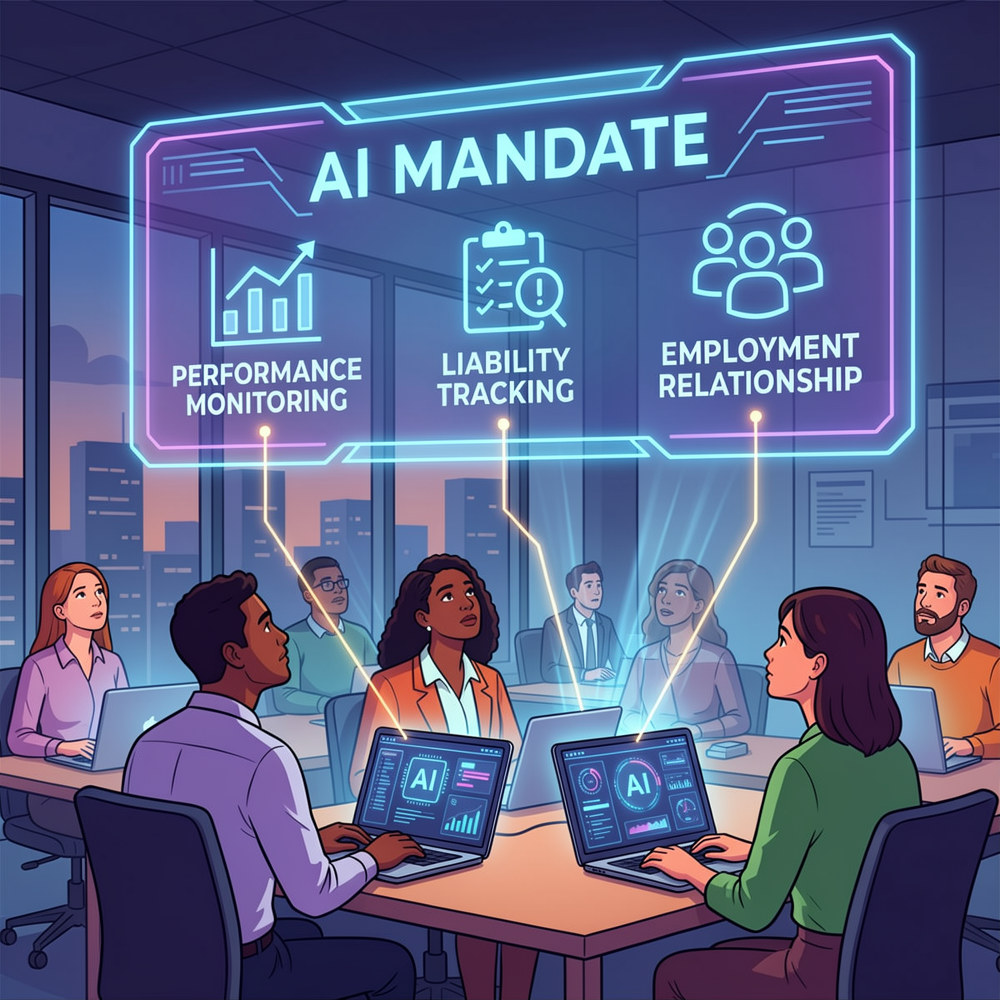
There is a sentence being spoken in offices across the region right now, and almost nobody has stopped to consider what it does legally. The sentence is: you must use AI.
For the past two years, most of us met AI as an invitation. A license appeared in the software bundle, someone ran a lunch and learn, and the curious went first. That period is ending. AI is now arriving as a mandate, wrapped into the enterprise packages organizations already sign with their technology vendors, pushed by clients who expect it, and measured against productivity and return on investment. As Reena put it in our session, it has become a race about who gets there first.
We hosted a conversation on this with Reena Roy, who looks at it through an HR and governance lens, and Sarah Khoja, who looks at it through employment law. What follows is what came out of it.
While AI is optional, the employee is making a choice. They picked up the tool. A great deal of the responsibility for what comes out of it sits with them, because they decided to use it.
The moment the employer mandates it, something shifts. The employer selected the tool, paid for it, and instructed the workforce to rely on it. That pulls responsibility back toward the company. You would expect, then, that companies mandating AI would have built a corresponding framework around it. Mostly, this is still evolving.
Sarah was direct about this. Yes, the company bought the tool and told people to use it, but the employee remains responsible for how they use it. The catch is that the employer is obliged to set out the framework first: how the tool may be used, when, and for what. If something then goes wrong, the employer has that framework to point to, and the conversation becomes a performance management conversation. The employee did not use it the way they were told to, or used it for something it was never approved for, and from there you move into performance improvement plans or disciplinary sanctions depending on what actually happened.
What Sarah is seeing in practice is that this embedding of protocols is not really happening yet. The pressure to adopt has run far ahead of thinking about process. Employers are behind on putting a structure around the tools they are mandating, and employees are not thinking about liability either, because when you are busy learning a new technology, exposure is not front of mind. Meanwhile other jurisdictions are already producing the fallout, most visibly in the Australian consultancy cases.
Here is the part worth sitting with. Where AI has been misused and the consequences are serious, the organization is going to be liable to its client regardless. That is not really in doubt. But the organization will then look back down the chain at the individual, and push some of that liability onto them in the form of personal employment consequences.
I asked Reena whether hesitation about AI is now a performance problem and whether it is showing up in reviews. Her answer contained a distinction that every manager in the region should be using, and almost none are.
There are three different people being lumped into one category. The first says I do not want to use AI. That is resistance to change, and it is a change management problem. Left alone it will eventually show up in productivity and therefore in performance, but it is not a performance issue in itself.
The second says I want to use AI but I do not know how. That is a capability issue, and you cannot fairly blame the individual for underperforming when the organization never gave them the skill set or the training to succeed.
The third says I know how to use AI, and I chose not to here because of the risks. Reena’s view, which I share, is that this person is the best outcome of the whole exercise. They are trained, they understand the technology, and they have the judgment to know when to use it and when to leave it alone.
Directionally, organizations will end up measuring AI adoption against productivity and performance, and eventually against incentives and pay. That is already visible in some companies internationally, and Reena expects the link to compensation to arrive in time. But the categories have to be separated first. Treating every nonuser as a performance problem is lazy and, given that two of the three categories are the employer’s own failure, hard to defend.
There is a live conversation about pay. I had read that morning that employees fluent with AI are starting to ask for raises on the basis that they are measurably more productive.
Reena’s experience is that the pressure is coming most strongly from genuine specialists rather than from general users. Experts working in generative AI with advanced technology know they sit at the top of the market and they say so. In her world this is handled through the concept of niche skills, which already exists inside salary banding. If someone can evidence that their niche skill is contributing to the business more than their peers, there is a premium available for it. The burden, importantly, sits with the employee and the manager together to produce that evidence.
We walked through the worst case. Someone uses the mandated tool, the output is wrong, and it reaches a client, a court, or a regulator. Who asks what?
Sarah’s list of questions is short and brutal. Which team produced it. Who used the AI. Who verified the product. Who supervised the person using and verifying it. Who was ultimately responsible for what went out the door.
Reena’s investigation, from the HR side, runs in parallel and asks slightly different things. Was there a mandate to use AI. Was the person who used it trained. Which tool did they use. Where was the human in the loop, because an employer mandating a tool should not be sending work to a client without someone checking it.
The two tracks then split. Damage control with the client is not the individual’s job. That belongs to whoever owns the relationship, and usually to someone senior. The internal analysis is separate: what happened, what went wrong, how do we stop it recurring. Where it was a genuine error, the answer is coaching and training. Where the investigation shows intent, it goes into the disciplinary process.
Sarah added the case that keeps employment lawyers awake, and it is neither of those. It is poor judgment. No intention to do anything wrong, but judgment so weak that the person still has to be held to account, usually because of their seniority or because they hold a technically important role. That is the hardest category to handle fairly, and it is the one most AI incidents will fall into.
Reena’s example of why this cannot always be pinned on the user is the recruiting pilot conducted by a large multi-national company. The tool was meant to shortlist the strongest profiles far faster than human recruiters could. Because the historical data held more male applicants, the system learned to surface male profiles as the ones the employer wanted, and the bias was embedded before anyone noticed. The project was scrapped as soon as this was identified. No amount of individual training would have caught that. Sometimes the fault is the tool, which is exactly why the investigation has to ask where the issue actually sits before anyone decides whether a person should be dismissed.
I asked about prompts, because the way many of us now work has changed shape entirely. We build skills and playbooks into the tools so they match our roles, and then we talk to them the way we would talk to a friend. None of that is recorded anywhere in most organizations.
Sara’s view is that courts are starting to want to see it. She said they are asking how something went wrong and where, and the prompts are where that answer lives. She described a matter, reported to her, in which a person generating a document for litigation had instructed the AI on tone, telling it not to use apologetic language. The tribunal was reportedly unimpressed to see the model being coached to communicate that way.
We already have regional precedent on the output side. Both the DIFC and the QFC have seen cases involving hallucinated authorities, judgments cited that simply did not exist. In those situations the law firm is accountable, and the client will hold it to account, because the embarrassment is shared.
We have to recognize that this region runs a commercially driven employment framework. The UAE federal labor law sets a floor of rights, leave entitlements and so on, but the ability to challenge an employer’s decision to dismiss is very limited. Arbitrary dismissal is now effectively confined to retaliation. If an employee raises a formal complaint externally, to the ministry, to the free zone, or to the labor courts, and is then dismissed, that dismissal is automatically unfair. Outside that, if the employer decides someone must be held to account for an AI failure and dismisses them, there is very little the employee can do about it.
Other grounds still exist. Bullying, harassment, and discrimination of a protected type would breach the law and could find a challenge. The financial free zones, the DIFC, ADGM, and the QFC in Qatar, prohibit discrimination and impose penalties for it, so a dismissal with a discriminatory element is challengeable there. Saudi offers somewhat more protection, since its law addresses termination for an unjustified reason.
So I put the obvious question to Sarah. Can an employee who is terminated stand in court and say the company mandated this tool, I used it as instructed, and this is not my fault? Provided they have received their notice, their leave, and their gratuity, no. There is no real challenge available.
In a mature unfair dismissal jurisdiction, the absence of training, instruction, or any usable protocol would be exactly the argument an employee ran, and it would often succeed. Here, it does not get off the ground. That asymmetry is the strongest argument I know of for employers building the framework voluntarily, because the law is not going to force them to and the reputational consequences of getting it wrong will arrive anyway.
Deploying AI, telling everyone to use it, and issuing a standard manual is not training. It is paperwork that produces exactly the outcomes described above.
Reena’s description of the real thing has several parts. Learning has to be continuous and individualized to the role, because one size genuinely does not fit here and jobs are changing underneath people as they learn. There has to be somewhere to go with questions. Working groups help, where people keep each other current and share experiences and mistakes openly rather than quietly.
The most important component is the part organizations skip. Verification. What to check, where in the process to check it, how to construct a prompt properly, how to test whether the prompt was sound, how to assess the risk of a given output, who to verify with, and precisely where the human sits in the loop. That is what has to be taught before you ask anyone to produce work with these tools.
Which brings us to the phrase we now write into every contract. Human in the loop. AI is unreliable by design. You cannot make a knife safe, and you cannot make a model that never hallucinates. Somebody has to check the output.
So I asked whether the checking is being written into job descriptions. Not yet. At the moment AI competence is treated the way Excel or PowerPoint once were, a tool listed on a resume, and Reena expects to see people describing themselves as certified practitioners on particular platforms, which will matter in screening and interviews. But the obligation to verify is not being drafted into roles, and if it is not in my job description, the fairness of holding me to it is at least arguable.
Sarah’s answer took this somewhere larger. As AI use becomes integrated, employees will be expected to do a great deal that today they would call outside their role. If the premise of AI is transferable skills, then an employment lawyer becomes an employment lawyer and a commercial lawyer, because the tools make the adjacent work possible. Job descriptions and contracts will become correspondingly general. We currently run a role focused employment model, and we are moving toward one built on skills, portability, and redeployment. You will be employed for what you can do rather than for a defined role, and the employer will reserve the right to move you.
Reena’s closing note on that point deserves repeating. Most of us signed a clause years ago saying our role may change. We agreed to this future already.
The final question I put to both of them was whether AI errors will be treated as capability issues rather than misconduct, and whether the distinction actually matters.
It matters enormously, and it is a moral point as much as a legal one. Misconduct is misconduct. Everything else is capability, training gaps, process gaps, structural gaps. We do not yet have structured frameworks for telling them apart, and building those mechanisms is work in progress in most organizations.
Sarah agreed with a caveat that should worry people. The genuinely difficult cases are where capability has degraded so far that it crosses into misconduct territory, and then you are into disciplinary process and potentially dismissal. It is a fine line.
For what it is worth, no employee has brought a claim against an employer on this in the region so far to our knowledge. We have had hallucination cases involving lawyers filing before courts, but no employment claims arising from mandated AI. Whether the lawyers involved in those matters faced disciplinary consequences is not public. It is difficult to imagine that they did not.
Reena’s closing image is the one I have kept. Artificial intelligence is ultimately a question of human accountability, and it rests on three legs. A board that takes ownership. Individuals who are accountable for designing the framework. Employees who are given the right tools and real access to training. Remove any one and the thing falls over.
Her own organization offers a sense of what this 3- legged stool looks like in practice. In Reena’s experience, the board of directors has formally taken responsibility for responsible AI use across the firm, monitoring adoption, return on investment, strategy, governance, and risk, and the firm has appointed a chief responsible AI officer. It is a starting point rather than an answer, and as she said, how it lands on the ground is still to be seen. But it is the leadership saying we are asking you to use this, and here is the structure we are putting around you so you can do it without exposing yourself or the firm.
Our jobs are changing faster than our contracts are. What I was doing last year bears little resemblance to what I do now. A recruiter told one of our audiences six months ago that he is seeing more and more legal engineer roles, and I have never written a line of code.
The one habit I would leave you with is cheap and takes minutes. When I draft for Women in Law, I write with one tool, then feed the result into a second and ask it to check the facts, then ask a third whether those facts hold. Cross referencing across models is not a governance framework. It is not a substitute for the protocols our employers still owe us. But until those arrive, it is the difference between catching the error yourself and having a client catch it for you.
Because the defense you cannot run is the one we started with. The company mandated the tool, so it is not my fault. That argument does not work here.
With thanks to Reena and Sarah for a great session that was both informative and enlightening.
©2025-2026 Women in Law. All Rights Reserved.
Maintained by Onestop Website Solution