
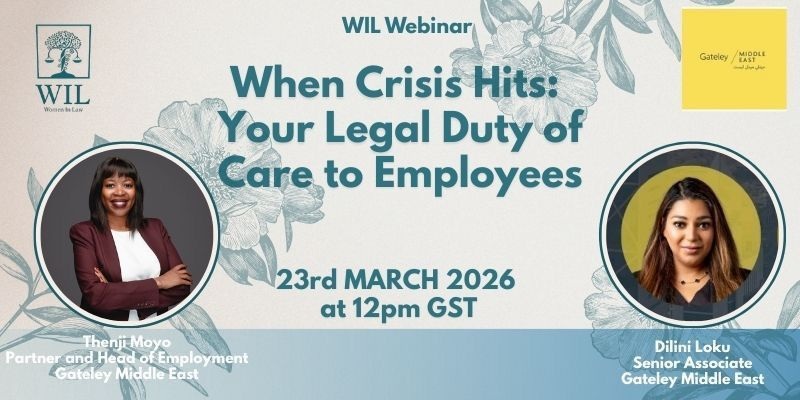
Today, we hosted an important and very timely webinar on the employer’s duty of care during the current regional situation. I want to say a genuine thank you to Thenji Moyo and Dilini Loku of Gateley Middle East for giving up their lunch break and showing up with such depth, clarity, and warmth. The questions from our community were brilliant, and this is exactly the kind of conversation WIL UAE exists to have.
For those who couldn’t join us live, here is a summary of the key legal and practical guidance shared. Please save this, share it with your HR teams, and if anything resonates with your situation, reach out to Thenji and Dilini directly. Their contact details are at the end.
From March 1, MOHRE recommended that private sector employers implement remote working arrangements to limit employee presence in open areas, except where physical attendance is genuinely essential. Jebel Ali Free Zone was among the first to make explicit announcements along the same lines.
What this means in practice is that employers need to do their own risk assessment: who are your essential workers, and who can do their job from home? That assessment is not optional — it is part of your duty of care.
Remote working is not an automatic right.
Most employment contracts tie the place of work to the business trade license premises. If you have moved employees to hybrid arrangements over the past couple of years, check whether those arrangements have effectively become a contractual variation, because reversing them may now require employee consent.
Know where your people are.
HR teams should have a clear picture of who is in the UAE, who is outside, and who cannot return due to flight disruptions. Emotional well-being matters here, too. A significant proportion of the UAE workforce is expats, away from family, and people are processing this situation very differently. The employers who check in, offer flexibility, and make people feel seen during a crisis are the ones who build real loyalty. That is not a soft point — it is a business point.
Document everything.
Any flexibility arrangements, policy changes, or workforce decisions made during this period should be recorded in writing. What we learned from the pandemic is that much of the litigation that followed stemmed from decisions made verbally, in good faith, with no paper trail.
This is one of the most practical areas to get right, and it is one that catches employers off guard.
UAE residents who stay outside the country for more than 180 days risk their visa being automatically cancelled. If you have employees currently outside the UAE due to flight cancellations or disruptions, you need to actively monitor this.
The good news is that the immigration authorities have confirmed that residents whose residency permits expire while they are outside the UAE will receive special concessions to enable their return. That is genuinely helpful and worth communicating to your teams.
For self-sponsored golden visa holders, there is now access to additional services, including emergency electronic return documents if a passport is lost or damaged, as well as general re-entry assistance.
The broader message: communicate with your employees. Let them know what protections are available, encourage them to register with their embassy or consulate, and if your organization has an evacuation protocol, make sure they are registered and up to date.
This was one of the most discussed parts of the session, and it is also one of the most misunderstood areas in UAE employment law right now.
Salary reductions and salary deductions are not the same thing.
Salary deductions are permitted under very specific circumstances set out in the Labour Law: pension contributions, court orders, and recovery of agreed overpayments. They are capped at 50% of the employee’s salary across all deduction types.
Salary reductions are something else entirely and are governed by Article 25 of the Labor Law. An employer does not have an automatic right to reduce an employee’s salary. Salary and allowances are fundamental entitlements, and any reduction requires the employee’s written, freely given consent.
If an employer presents a salary reduction as “accept this or go” and the employee later challenges that consent, it will be scrutinized. The process matters. You should have documentary evidence of the business reasons, records of any consultation, and a written amendment to the employment contract. Where a reduction is agreed, it should ideally be time-limited — for example, three months — with the salary reverting to the original amount thereafter.
WPS compliance is also critical.
Under the Wage Protection System, employee salaries are registered. If a salary reduction is agreed but not updated in the WPS system, the continued shortfall against the registered salary can trigger compliance issues, fines, and further exposure for the company. If you are considering salary reductions, take legal advice first, document the process properly, and update your WPS records.
The UAE Cyber Security Council has reported that cyber threats and scams in the region have increased by 40% during this period of remote working. People are receiving fraudulent messages appearing to come from official sources, and misinformation is spreading rapidly across social media platforms.
As an employer, your duty of care extends here, too. Make sure your employees:
The UAE Cybercrimes Law applies to individuals, and the penalties are serious. There have already been arrests in recent weeks. Retrain on data protection, refresh your IT security protocols, and make sure your IT support team is ready to handle remote access issues.
If your organization does not have a current business continuity plan, this is the moment to put one in place. Key contacts, communication protocols, what happens in the event of an outage or a cyber incident, and who covers what if team members are unreachable. Regulated businesses in particular should review and activate these plans now.
Thenji and Dilini closed with a point worth highlighting separately. How organizations communicate publicly during a crisis matters. Statements that come across as tone-deaf or lacking in compassion attract significant negative attention, and that reputational damage can be lasting. Think carefully about the messaging your organization is putting out — internally and externally.
©2025-2026 Women in Law. All Rights Reserved.
Maintained by Onestop Website Solution