
Presence Begins Before You Speak
Let us begin with an uncomfortable truth. Most of the women who attended our recent session on presence have already done the hard part. We studied. We qualified, then overqualified. We sat the exams, survived the billable hour, and earned our seats in rooms that were not always thrilled to see us arrive.
And yet. When the board meeting starts, or the leadership team turns to us for the answer, the outcome rarely hinges on the footnotes. It hinges on something harder to bill for: how we show up in that room, in that moment.
Our guest speaker, leadership advisor MD. Crina Ancuta, opened the session with a breathing exercise. To feel the chair beneath us and call our scattered energy back into the (Zoom) room. Then she asked a simple question: what would it mean for you to be present, here and now?
📱 The thief in your pocket
Crina named the culprit early, and we all recognized it. The phone that delivers terrible news every minute. The new demand on the Teams chat. The business WhatsApp from someone who needs something yesterday. The boss who has decided to share, quite openly, exactly what has upset him today.
Every one of these pulls a thread of our attention. Pull enough threads and there is very little of us left in the conversation.
We like to think the greatest gift we bring to a client or a colleague is our expertise. Crina gently suggested otherwise. What people feel first is our energy, and our energy is shaped by whether we are truly listening to the person in front of us.
She also made a confession that landed with a few knowing laughs. She is never as present when her camera is off. Being seen, she said, is her accountability partner. Something to consider the next time we join a meeting as a small gray square with initials.
🎯 Your presence arrives before you do
We are perceived by our audience before we say a single word. Presence begins the moment we walk through the door, and in truth it begins days, weeks, months and years before that.
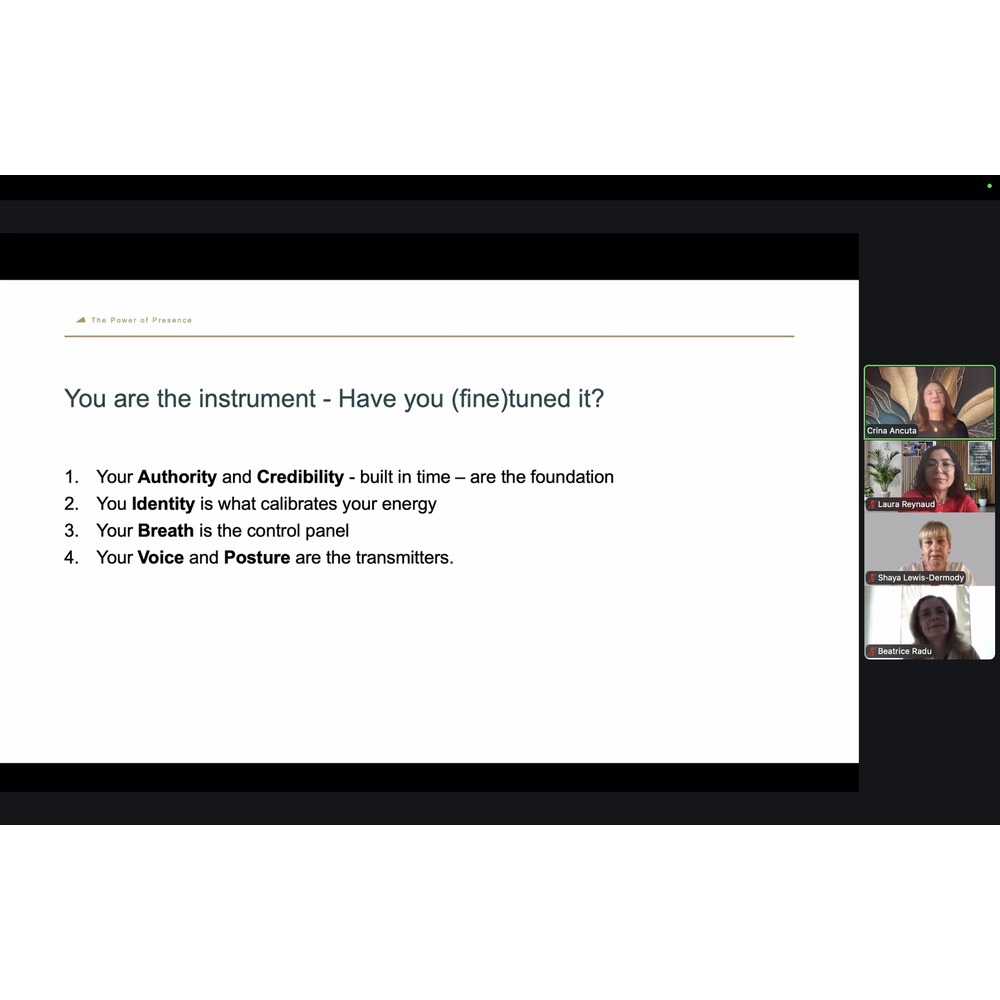
Crina built her framework on three words: authority, calm and credibility.
Authority is the expertise you bring. What do you know that nobody else in that room knows? For a room full of lawyers, she was blunt. You are the expert. That is not something to negotiate. That is something to claim.
Credibility is how visible you have made that authority. It is tempting to say the leadership team never has time for us, that they are too busy orbiting the CEO. Crina had little patience for that story. Showcasing our results is our responsibility. When we take our power back, we accept full responsibility for how the right people see us.
Both of these are foundations, and both are built over time. The good news is that a great deal of each is within our control.
🪞 Who are you in that room?
Beneath authority and credibility sits a quieter layer, the conversation we have with ourselves before we ever step inside.
Who am I in that room? What is my intention? What energy do I need to bring? And underneath all of it: what do I believe about myself?
If the inner script reads “I am never seen, I am never heard,” the room will usually oblige. If it reads “I have the right to share my expertise, and this room will welcome what I bring,” the room tends to follow that lead too.
Crina put it plainly. You are the instrument. Your body, your mind, your emotional control. And the breath, she joked, is the control panel.
🌬️ Breathing like you mean it
A few slow belly breaths can shift us from anxious energy to grounded energy, and nobody at the table needs to know we are doing it. Slowing the breath signals to the brain that we are not under threat. Calm, Crina reminded us, is what gives us control over a room. Anger and fear can win an argument now and then, but they rarely win the room.
When one participant asked for a specific exercise to use before a meeting, Crina offered a practical sequence. Start by checking your energy. Are you angry? Wired? Excited but running very hot? If you are highly activated, sitting still on a cushion will not cut it, so move first. Step out of the office and walk around the block. She promised it works miracles.
Then turn to the breath itself, and make the exhale longer than the inhale. Breathe in through the nose for four counts and out for at least six, or aim for double the length of the inhale. If a long exhale through the nose is hard, Crina shared a tip she credited to Andrew Huberman: breathe out through the mouth with your lips pressed thin, as if blowing out a candle very, very slowly. Four or five rounds and you will feel yourself settle.
She also borrowed a favorite image from Brené Brown about keeping an open heart and a strong back. For those who want the original, Brown’s phrase is “strong back, soft front, wild heart,” which she learned from Zen teacher Joan Halifax and writes about in Braving the Wilderness.
🤝 Warmth is a strategy
The part of the session that sparked the most conversation was about warmth.
Crina shared research from a professor at the University of North Carolina who studies how people respond to leadership behavior. Based on the details, this appears to be Alison Fragale of UNC Kenan Flagler Business School, author of Likeable Badass: How Women Get the Success They Deserve. Her work argues that women do best when they project both warmth and assertiveness.
Many of us know the double standard well. A man is assertive. A woman saying the same words in the same tone is “aggressive.” Crina’s advice was to spend less energy resenting how society reads us and more energy learning to move through it.
The key is reframing what warmth means. You do not need to become someone else. Warmth can come from your care about the outcome and your intention for the people you serve. When the purpose is bigger than our own next promotion, warmth stops being a performance and becomes simply true.
I shared an observation from a law firm roundtable I had attended the day before. Every partner at that table had the same quality. They were all warm. None of them were in the business of announcing their own brilliance. They understood something essential about our profession: we are service providers. We work on behalf of others. In our region especially, warmth matters enormously, alongside knowledge and the ability to show that knowledge.
Crina added a line I wrote down. Warmth flows from knowing you are good. Your contribution will be good, not perfect, and you do not need to force it because you trust yourself.
🏆 Rehearsing the win
We closed with a guided visualization. Each of us pictured one high stakes moment ahead. Crina asked us to recall a time someone thanked us and told us that our voice or our action had changed their life. Then she asked us to see the woman walking into that future room. How is she standing? How does she look around? She carries just the right amount of smile, and she knows that the people in that room need her expertise, even if they have never admitted it.
Then we skipped ahead to the celebration: the text from a friend, the congratulatory handshake, the taste of a favorite drink, even the scent of the perfume worn for courage. It was surprisingly moving to sit with the evidence of our own impact for once.
Afterward, I talked about how I keep a folder on my desktop called the Tada folder. Every kind email and every thank you goes in. I learned the tool years ago in a course on impostor syndrome. Most of us, I suspect, could say the same. We all have these moments. We simply do not take the time to remember them.
🌱 Solitude, company and battle
Crina left us with a thought that came to her, of all places, while blow drying her hair that morning. Presence is found in solitude, where we connect with who we really are. It is elevated in the company of others, like a mentor, a wise friend or a room full of women doing this work together. And it is forged in battle, in action, when we push past our discomfort and ask for our place.
She told us about deciding to claim a speaking spot at a conference because she knew she had something valuable to add. It was not easy. She did it anyway, because the room needed what she had. Use whatever helps you get there, she said. For her that day, it was a pair of high heels she no longer loves but still trusts to remind her of her power.
📚 On my nightstand: Executive Presence
If this session left you wanting more, I warmly recommend Executive Presence: The Missing Link Between Merit and Success by Sylvia Ann Hewlett (Harper Business, 2014).
Hewlett is an economist and the founder of the Center for Talent Innovation. Her team surveyed nearly 4,000 college educated professionals and concluded that executive presence rests on three pillars: how you act (gravitas), how you speak (communication) and how you look (appearance). Gravitas carries the most weight. Hewlett reports that 67% of senior executives see it as the core of executive presence.
What I appreciate most is the honesty of the title. Merit gets you into the room. Presence decides what happens once you are there. That is precisely the gap Crina asked us to close.
The book pairs beautifully with this workshop. Hewlett gives you the research and the framework. Our session gave you the breath, the mindset and the rehearsal.
📝 Your homework (the pleasant kind)
Pick your moment first. Name one high stakes conversation coming up and write down two or three qualities you want to bring into it. Before your next big meeting, practice the long exhale: in for four, out for six or more. Start your Tada folder today, or revive the one gathering dust, and put one thank you in it. And read Executive Presence, then tell me which pillar you plan to work on first.
The credentials got us here. Presence is how we make the room count.
With warmth,
Laura
🔗 Sources
Sylvia Ann Hewlett, Executive Presence: The Missing Link Between Merit and Success (Harper Business, 2014); survey details as reported by SUCCESS (success.com/?p=22109) and the publisher’s description via Tattered Cover (tatteredcover.com/products/9780062246899).
Alison Fragale, Likeable Badass (Doubleday, 2024), and her UNC Kenan Flagler profile (kenan-flagler.unc.edu/news/teaching-the-science-of-success).
Brené Brown on “strong back, soft front, wild heart” (brenebrown.com/podcast/brene-on-strong-backs-soft-fronts-and-wild-hearts).