
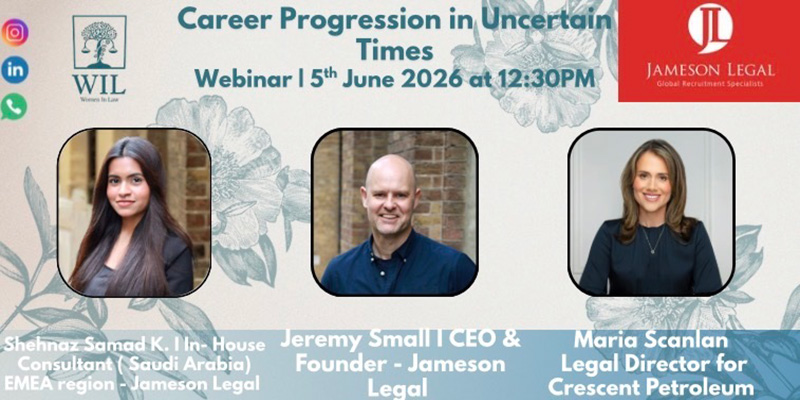
When I sat down to moderate our latest Women in Law UAE panel, I knew the conversation would be honest. I did not expect it to be quite this useful. We had gathered to talk about a region and a profession that are both in flux, and over the course of an hour the discussion moved from the very immediate question of how the legal market has weathered the regional conflict since late February, through the human realities of leading teams in a crisis, and on to the change almost every lawyer now feels pressing in: artificial intelligence.
I am sharing the highlights here, because the themes deserve a wider audience than one room.
Joining me were Maria Scanlan, General Counsel at an energy company operating across the region, and Jeremy Small and Shenaz Samad Khan, both legal recruiters with a close view of hiring across the Gulf. In house and external, senior and junior, their perspectives gave the conversation real texture.
The first question on everyone’s mind was whether the legal market has frozen. The answer from our recruiters was more nuanced than the headlines suggest. Jeremy described a patchy picture rather than a uniform one. Some clients, particularly large oil and gas companies with sizeable legal teams, have continued hiring as before, having long been prepared for volatility. Others have paused or reshaped roles, with the general expectation that those positions will be picked up once the current crisis eases.
What has genuinely slowed, he noted, is the flow of new roles coming online, compounded by the approach of the quieter summer months. Senior candidates in particular have grown cautious about starting a process they might not see through. But the feared exodus has not materialized. Most people who left did so temporarily, and many who departed for good were already contemplating a move that the conflict simply accelerated.
“The Middle East is really the place. I don’t see that demand diminishing massively.” Jeremy, on why lawyers still want to build careers in the region.
Jeremy went further, suggesting the region may see a short mini boom once stability returns, perhaps lasting six months, similar to the period after Covid, as paused roles and pent up demand return to the market at once. His advice to anyone intent on moving was to watch for that window and use it. Shenaz reinforced the point. The Gulf market has proven remarkably resilient, and interest from candidates abroad continued even at the height of the disruption. The clearest divide, she observed, is between those with genuine connections to the region, who understand the reality on the ground, and those whose impressions are shaped only by media coverage and who remain more hesitant.
Maria offered a vivid account of how the in house role shifts during a live crisis. Her company already operates a crisis management team and is accustomed to convening at short notice in response to serious security incidents. In these moments, she said, everyone looks to the lawyers, and the work expands well beyond legal advice into something closer to general strategic counsel.
Her example was telling. When the conflict escalated, it was Maria who proactively raised the question of whether the company’s political violence and terrorism insurance coverage was adequate given the use of missiles. In a crisis, she observed, people react to what is directly in front of them, and the longer term implications can be missed. Part of the lawyer’s value is bringing exactly those medium and longer term risks to the fore.
“We have to have a 360 view of what’s going on around us and try to be the adult in the room.”
This connects to a broader shift the panel kept returning to. Chief legal officers and general counsel are no longer expected to be purely technical experts. They are expected to be strategic, commercial, and deeply involved in company strategy. Hiring managers, Maria noted, are increasingly looking for lawyers who can be flexible in difficult, uncertain situations, not simply those who know black letter law.
Asked what distinguishes good lawyers from those who emerge as leaders under pressure, the panel was united. Shenaz argued that at senior levels the differentiator is rarely the sharpest legal analysis. It is the confidence, clarity, and judgment to keep a team and a business functioning, and the willingness to do more than the day to day strictly requires while instilling confidence in others.
Jeremy added that a modern lawyer wears many hats. Beyond legal advice lies strategic and commercial counsel, as well as the ability to be a calming presence for the C suite. He noted candidly that some technically excellent lawyers simply cannot manage the stress of high workload pressure, and that the capacity to stay calm and methodical is a genuinely valuable skill, one that earns lasting trust for the next crisis.
I shared a phrase from my own leadership that captures it. We have to be like ducks, serene on the surface while paddling furiously underneath. But Maria offered an important counterpoint. While projecting calm matters, she has noticed that in high stress moments people also want their humanity recognized. Rather than a relentless keep calm and carry on stance, many colleagues, especially younger millennials and Gen Z, respond to genuine acknowledgment that times are hard. Leadership now requires emotional intelligence and the flexibility to manage up differently from how one manages down. A little vulnerability, used carefully, can go a long way.
“You can be the most technical lawyer in the world, but if you don’t have EQ, you may not be as successful.” Maria
The conversation then turned to AI, which Jeremy likened to an incoming tsunami. Over the past 18 months he has watched attitudes shift from “we might consider it” to “we cannot survive without it,” particularly among law firms but increasingly in house too. Companies now expect legal teams to be as efficient as possible, to reduce external spend, and to demonstrate a return on their technology investment.
One striking development is the rise of the legal engineer: trained lawyers who move into tech companies and help mold AI tools around a specific area of practice. Jeremy gave the example of a fintech firm his team was instructed to work with that week, which needed genuine subject matter experts to work alongside its technical teams because AI alone could not grasp the nuances of the work. Encouragingly, he also noted that in house teams are in some cases growing rather than shrinking, as accessible tools allow organizations that never had lawyers to begin building legal capability.
Shenaz, speaking from the junior perspective, struck a more cautionary note. The traditional path to judgment ran through years of high volume, repetitive work. If junior lawyers lean on AI from the outset, she warned, those assessment and judgment skills risk eroding over time. Her call to action was for firms and in house teams to invest seriously in robust training and development so the profession survives the transition, rather than blindly adopting the technology. She also pointed to a constructive use of AI: as a tool for feedback on one’s own behavior in meetings, a way to build emotional intelligence rather than replace it.
“While we adopt it, we need to make sure we don’t lose the assessment and skill sets that have made senior leaders reach where they are.” Shenaz
Maria agreed that AI already delivers real efficiencies in summarizing, note taking, and routine tasks once handed to trainees. But she flagged the persistent problem of hallucinations and the high level of senior supervision still required, to the point where the time saved is sometimes illusory. She made a practical plea to colleagues: get legal involved when your organization is procuring AI and contract management tools. Too often these systems are chosen without legal input and end up unfit for purpose from a legal standpoint. She has made becoming AI literate a personal KPI, and encouraged others, senior and junior alike, to do the same.
Jeremy underlined the scale of the hallucination problem, citing studies pointing to rates around 15 percent, a figure he called enormous, and warned that the issue grows more dangerous as the technology improves and its errors look more convincing. He held out hope for emerging approaches such as neuro symbolic AI, which may bring reasoning and reduce hallucinations within a few years, but stressed that getting to grips with AI now is essential for any lawyer’s future.
The panel closed on the capabilities that will resist automation. Jeremy listed strategic advice, commercialism, a genuine 360 view of the client’s business, openness to new technology, and empathy. The technical skill that AI seeks to replicate is only one part of a lawyer’s role, and it is the soft skills that will keep lawyers in their careers longer.
Maria added creative thinking, the ability to work in the gray rather than in black and white, and the ability to read a room. With so much of communication being nonverbal, the senior lawyer’s instinct for personalities and unspoken cues remains, for now, beyond the reach of any machine.
A closing question from the floor captured the anxiety many feel. Could AI recruitment screening unfairly filter out nonlinear careers, such as a move between contracts and regulatory roles? Jeremy acknowledged the worry, especially for younger applicants facing fully automated processes with no human feedback, but reassured the room that in legal recruitment he is not yet seeing this, as his teams still liaise directly with hiring managers and senior lawyers.
If there was one thread running through the whole discussion, it was this. In a market shaped by conflict and reshaped by technology, technical excellence is the entry ticket, not the prize. Judgment, calm, emotional intelligence, creativity, and the willingness to keep learning are what will distinguish the lawyers who lead. At Women in Law UAE we will keep building the spaces, for soft skills, for leadership, and for the future of the profession, where those capabilities can grow.
With thanks to Maria, Jeremy, and Shenaz, and to everyone who joined the conversation.
©2025-2026 Women in Law. All Rights Reserved.
Maintained by Onestop Website Solution